Sunday, December 20, 2009

Martijn Henkriks


Martijn Hendriks

Work from his oeuvre.

There is a good interview here.

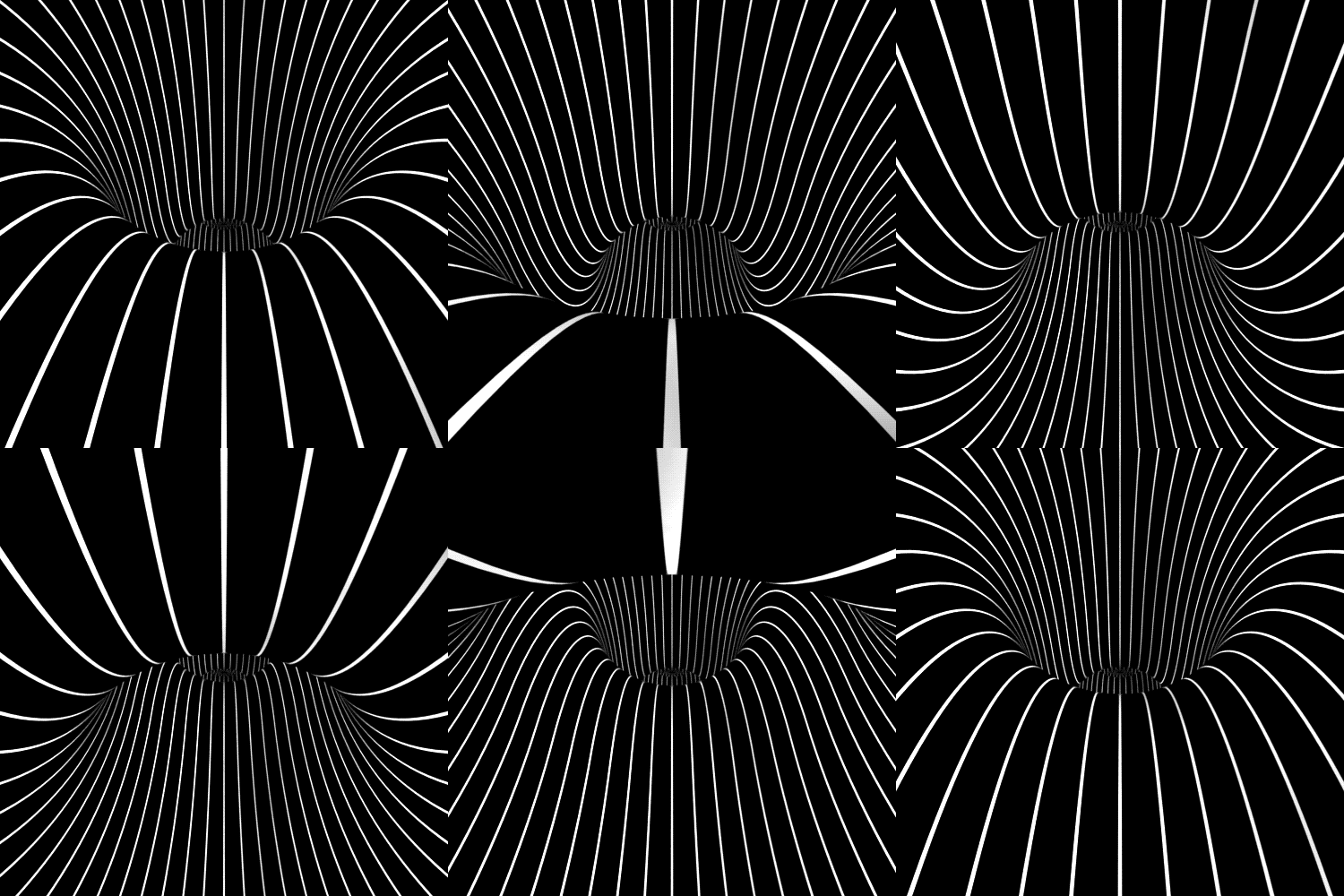
"Martijn Hendriks’s videos, sculptures, and installations often involve seemingly unproductive gestures. Exploring how such unproductive acts like displacements, mistranslation, removals, withholding things, obstructions, overdoing things, repetition, mismatchings, and attempts at impossible or redundant tasks may become productive, a common thread in his work is the possibility of transformation, or how one cultural object or gesture may turn into another. He often uses any materials available, ranging from found images, forms and references culled from art historical sources, to existing objects, texts, film and video footage, Google image searches and viral videos downloaded from the internet." - Martijn Hendriks


Saturday, December 19, 2009

Peter Sutherland


Peter Sutherland

Work from his website (narrative home page below).

"When I was a kid we lived in Michigan (until we moved to colorado when I was 8). We had lived on a lake, we had a big back deck my dad had built. Past that there was a long lawn leading up to the shore of the lake. The house sat on a hill so it almost l felt like you were looking out into a valley when you looked at the water. The deck is a blurry memory but it was a stage for some very visual moments. We had 2 cats, one was grey one was orange, their names were Casper and Astoria. My parents had large paintings with one orange and one grey cat. I found it hard to understand why they had these, and which had come first, the paintings or the cats. The grey one got really sick once, I walked out onto the back deck and saw him sitting on the railing and there was a bunch of ooze coming out of his ear. It looked like vomit was coming out of the inside of his head. The cat's face looked really unhappy as if he knew the end was coming. It freaked me out and I think the memory of that cats messed up ear turned into a series of bad dreams. The dreams were about a large skunk, who had some human qualities and sharp teeth. In the dreams the skunk always wanted to come in the house, it would patiently hang out on the back deck and wait to come in, other times it would be more frustrated and anxious to enter the house . These were very scary dreams and I'm getting chills as I'm writing this. I have another memory of the first time I looked at the eclipse from the deck. I must have been 6, the eclipse came and all the children were warned not to look directly at it because it would ruin your eyes. My dad went to the shed and pulled out a weldiing mask. Everyone in my family passed the mask around and took turns staring up the eclipse. The tint on the welding glass was so dark that the eclipse looked like a red circle. Another time we were out on the deck and there was a meteor that dropped and i remember looking right at it and I could hear it sizzle. It looked like it might have fallen into the lake but my dad assured me it was far away and had probably burnt up when it got near the earth. So yeah, the back deck, the bloody ear, the skunk with sharp teeth, the mask, the red circle, the sound of the meteor, and the joy." - Peter Sutherland (the links are missing, so go to his actual site).

Friday, December 18, 2009

Barbara Breitenfellner


Barbara Breitenfellner.

Work from Collages.

"(...) One could say that Barbara Breitenfellner essentially „exhibits exhibitions“, every installation becoming an exhibition in itself, like those we can find in crappy private collections, in strange American suburban museums or even in trendy art galleries.

For her show at CAPRI, the artist presents printed works for the first time. Like her installations, they are based on found objects and materials e.g. pages from books on which she has printed etchings taken from 19th century dictionaries? illustrations or tattoo magazines, and dots resulting from the enlargement of images printed in newspapers. Again, it is in the bizarre signification, the non-logical links, the un-canniness of the mental collage that those prints find their raison d‘ĂȘtre, more than in an obvious explanation or too direct „beautiful logic“.


Those cut-up silkscreens remind us of JG Ballard who, in The Atrocity Exhibition writes: „Kodachrome. Captain Webster studied the prints. They showed: (1) a thick-set man in an Air Force jacket, unshaven face half hidden by the dented hat-peak; (2) a transverse section through the spinal level T-12; (3) a crayon self-portrait by David Feary, seven-year-old schizophrenic at the Belmont Asylum, Sutton; (4) radio-spectra from the quasar CTA 102; (5) an antero-posterior radiograph of a skull, estimated capacity 1500 cc; (6) spectro-heliogram of the sun taken with the K line of calcium; (7) left and right handprints showing massive scarring between second and third metacarpal bones. To Dr. Nathan he said, 'And these make up one picture?'“ Barbara Breitenfellner would doubtlessly answer „yes!“" - Thibaut de Ruyter for Capri

Thursday, December 17, 2009

Michael Johansson


Michael Johansson

Work from his oeuvre.

"In his playful installations and sculptures Michael Johansson puts the qualities from daily life objects in opposition to their field of application. By repetition, displacement of scale and new function he questions the receivers interpretation of the unique.

In the exhibition Strings Attached at Nordin Gallery the work Some Assembly Required will be on display, a lifesize model kit of a bike. A real bike is turned back into a space of imagination and spins concepts such as size and belonging. Some Assembly Required is a common text on boxes for model kits, alerting the buyer that whats inside will differ from the image on the cover. But the title also refers to the necessity for the audience to participate in the work for it to reach its full potential.

In Engine Bought Separately everyday objects from mid-20th century housewives are taken apart, sorted, and repacked in an equally outdated boydream esthetics. These two worlds are merged together and the objects are frozen in their new shape – while the function is displayed, the functionality is taken away.

Kitchen Assembly is made of a kitchen table and two chairs that has been taken apart and assembled within a three dimensional framework which also plays the role as new table legs. Some of the tables original character and function still remains but the furnitures has taken one step in the wrong direction in the line of production. They are transformed into
a model of themselves, and their original purpose has given way to something else." - Nordin Gallery

Wednesday, December 16, 2009

Marlo Pascual


Marlo Pascual

Work from her oeuvre.

"I’m creating a relationship between the artwork, the art space, and the viewer by employing visual and audible devices. In recent sculptures I’ve juxtaposed found photographs and objects with various light sources to create a mise-en-scene for them to play out in. The unknown actors and actress in the images are recast into new roles, with theatrical light sources such as candlelight, fluorescents, and color gels providing dramatic tension. The sculptures become a site of convergence between past and present, fiction and reality, and drama and banality; where the subjects play out ambiguous narratives with psychological and melancholic resonances." - Marlo Pascual

via i heart photograph

Tuesday, December 15, 2009

Larry Sultan and Mike Mandel


Larry Sultan and Mike Mandel

Work from Evidence.

Below is a section of Larry Sultan's (1946-2009) obituary from the New York Times, Larry died yesterday in California.

"...In the mid 1970s using a grant and a letter of introduction from the National Endowment for the Arts, Mr. Sultan and Mike Mandel, who had met as students at the San Francisco Art Institute, somehow managed to persuade several large companies, agencies and research institutions like the Bechtel Corporation, the Jet Propulsion Laboratory, the San Jose Police Department and the United States Department of the Interior to let them rummage through their documentary photo files.

Highly influenced by the West Coast brand of Conceptualism then percolating out of places like the California Institute of the Arts, both men were interested, as Mr. Mandel later said, in exploring photography as “more than just the modernist practice of fine-tuning your style and way of seeing.” The pictures they chose from the archives, out of the hundreds of thousands they examined, were a strange, stark, sometimes disturbing vision of a late-industrial world: a space-suited figure sprawled face down on a carpeted floor; a car consumed in flames; a man holding up a tangle of weeds like a trophy; a shaved monkey being held down by a gloved hand.

Some of the images seemed to have been picked for their uncanny resemblance to installation art being made at the time. But the 59 photos published, with no captions to explain what they showed or where they came from, pursued a much broader, Duchampian agenda of harnessing found photographs for the purposes of art while using them as a way to examine the society that produced them. The critic Kenneth Baker of The San Francisco Chronicle wrote that the project demonstrated brilliantly the degree to which “we have no calculus to unravel relations between what a picture shows and what it explains.”..." - Randy Kennedy for the New York Times

Monday, December 14, 2009

Mariah Robertson


Mariah Robertson

Work from I am Passions.

"A growing number of contemporary photographers seem to be forsaking the ease and polish of digital image making for the romantic uncertainty of the darkroom. Mariah Robertson, who has shown at the SoHo gallery Guild & Greyshkul, which is now defunct, and is currently having her first solo show in Chelsea, is going a step further. In a giddy, colorful and highly experimental series, she cuts up negatives, splashes chemicals around and leaves the edges of her prints raw.

Ms. Robertson trained as a sculptor and she clearly thinks in three dimensions. Her pictures are multilayered, with cubes as a prominent motif. (Others include palm leaves and male nudes.) There are also quilt patterns and echoes of scattered-square Dada collages.

The combination of photographic techniques, often in the same picture, produces a wonderfully unstable field. Objects and abstract forms seem unmoored, slippong between the immediacy of the photogram, in which an object is placed directly on sensitized paper and exposed to light, and the more remote, mysterious processes of the C-print and gelatin silver print.

Given how much is happening at the abstract and technical levels, the nude figures are distracting. And the roughly scissored edges of the prints, meant to remind us that these are singular images, sometimes detract from their beauty. But Ms. Robertson makes a strong case that photography isn't just for perfectionists." - Karen Rosenberg for the New York Times


Sunday, December 13, 2009

Daniel Gordon


Daniel Gordon

Work from Portrait Studio.

"Brad Phillips - Hi Danny. Daniel? You just opened a show at Groeflin Maag Galerie in Zurich. I know you usually take a while to work on a single body of work - so what's this body of work about?

Daniel Gordon - Hey Brad. Yeah Danny is okay. It's funny, we've never met in person, but I've seen a lot of your work in the flesh and we've definitely spent time in some of the same places with the same people--I'm thinking Zurich, Claudia and Davia etc. We've probably been in the same room together at some point and just not known it, so I hope we get a chance to hang out next time you're in New York... Anyway, yes, I just opened a show at Groeflin Maag Galerie in Zurich, and I also made an artist book with Onestar press to accompany the exhibition. Both the book and the show are titled Portrait Studio--I'm really psyched about how they turned out. The truth is that with my new pictures, I had no real direction until I started making work. So I was in the middle of the project when I began to see the threads of what "The Portrait Studio" could be. In other words, this project didn't start as an idea, the idea came after I had started. I think that's why it took me a while to finish. Initially I saw an artist/muse relationship emerging in the way I was approaching my "subjects" in the studio. Eventually, I started researching that element, taking more direct inspiration from historical relationships that have had that dynamic. I think Alfred Stieglitz and Georgia O'Keeffe are a good example of this. Another one is Dr. Frankenstein-who's "practice" is similar to mine when creating his monster: slamming together body parts to create a new being. I became aware that how I put these pictures together drastically influences what kind of artist/muse relationship, or story would be told, from horror to exploitation to love and beauty. I tried to combine and complicate those themes.

BP – You've definitely managed to connect horror to beauty in these works. There is something both scary and tender in many of the pictures. In a way it relates to your earlier photographs where you were 'flying' - I felt immediately scared for you, and there was an element of horror in wondering just how you were going to survive the jump. But at the same time they were tender and beautiful, just you in your long underwear soaring through nature. Are the new works a permanent move away from 'straight photography'? Do you think that in making these sort of collaged works that you've closed a door in your practice? And on a technical note, are these pictures spliced together manually or digitally? I really have to say that when I saw these works in person in Zurich, I felt confident that they were something I had never seen before, something brand new and fully formed. It's funny to me how fucking with our sense of dimensionality can become very unnerving.

DG - Mmmm. Well, there's a lot of questions there. Let me first say that I'm glad you brought up my flying pictures, because as you touched on, I think they relate to what I'm doing now. I believe that the art of photography has to do with making ordinary moments extraordinary. If I look at what I'm making now, and what I've made in the past, on a fundamental level, I don't see varying degrees of 'straightness' in my work, but rather a continued investigation into this phenomenon that seems like magic--and it's easier to just call it magic, but in truth, I think it's really a complex combination of factors that create the possibility of allowing the camera to transform what is in front of it's lens. And this isn't a new idea at all--even for old school street photographers like Friedlander, Papageorge, Arbus, Winogrand, etc. etc. I mean, I know I make pictures in different time and in different ways than that crew, but deep down I am interested in what they were interested in: Transforming space, light, and time photographically in order to create something that never really existed the way we see it in a photograph. So when I'm in my studio, and I'm printing pictures mostly found on the Internet, cutting them up, combining them in different ways to create a kind of 3-D collage, I don't really know if this thing I made will work until I look at it through the camera--sometimes it comes to life, and sometimes not. This process is not dissimilar to photography sometimes enabling me to achieve human flight, and other times I'm just an idiot flopping around a few feet off the ground in long underwear. So, I think that I'm as straight a photographer as you can be--I photograph what's in front of my lens and don't alter anything once I've made the exposure. For me, the magic is in the moment.

BP - The magic in the moment, that's something that keeps coming up lately. It makes you wonder about the shift between research based artists and artists that are still interested in what you called 'magic'. A bit of a modernist hangover in a way. I'm very interested in that moment you're talking about, as it relates to intuition, which is something I’ve always thought was invaluable when it comes to making good work. Have you reached a point in your working life where intuition is enough for you? Can you start working on a scrap of instinct and trust that the idea will sort itself out in a rational way over time? Because the shift in subject matter in your work over the past few years would imply to me at least, that you are comfortable going wherever your imagination takes you. And imagination has almost become a dirty word.

DG - Yeah, it's totally a dirty word. It's funny, when my girlfriend, Ruby Stiler, was in art school she and a friend had an ongoing competition to see who could use the word 'imagination' the most times during a critique. I'm not sure if there was ever a winner declared, but, in the midst of such a critical environment it was definitely good for laughs. In a way, the word 'imagination' negates the intention of the artist, and can potentially minimize the content of the work. But don't get me wrong, I value imagination, I'm just not sure if it's a constructive way to talk about art. As for intuition, I'd say that most of my favorite artists worked/work intuitively, from Philip Guston to Stephen Shore, whose work is very conceptual. I think the important thing to realize about intuition is that it is a place to begin, and when it's brought me somewhere that I believe is interesting, I then have to work really hard to figure out what it means to be there, and to develop the aspects that seem meaningful. For me it's much more interesting to feel my way around than to plan and execute. I'm not suggesting that an artist shouldn't be critical or smart, I guess I just wonder, why make something if you know exactly what it's going to be like when it's done. That just seems so boring to me. So yeah, I'll follow a scrap of intuition until it leads to a dead end, and then I'll follow another one, and another one- following the scraps might be the most compelling part of making the work.

BP - Well I definitely agree with you that following the scraps of intuition can be the most compelling aspect of making work. But for me, process based work, work about getting to the product, ends up being a bit of a boring object lesson. There are a lot of similarities here between what you're saying about arriving at a body of work, and eastern philosophy. And more and more lately I'm making this connection to the activities of artists I really admire. Anyway, you are also sort of a magician, or an alchemist. So you are supposed to keep the methodology of the trick hidden. The flying pictures are perfect examples of a magic trick, and emblematic of sort of 'putting one over' on the viewer, which I like. I like some antagonism towards the viewer. In your piece 'Orchid' - there is so much going on, and I can't imagine how it was made, and I don't understand the lighting, and I don't understand the shapes, and this culmination of misunderstanding can often lead to at least a vague new kind of understanding. Not to ask you to reveal your secrets, but for example, how was that piece made?

DG - I searched for images on the Internet, printed them, constructed some of them into 3-D objects sometimes using foam core as an armature, while I let other found pictures remain 2 dimensional. So in a sense I make a 3-D collage, light it, and then photograph it either with a 4x5 field camera or an 8x10 view camera. For me though, it's the things that give away the illusion that complicate things, and make the pictures more interesting. Recently I've been pushing my pictures more and more in the direction of revealing as opposed to concealing. So when I talk about magic, I'm really just talking about how amazed I am at what the camera can do. When I think about illusion on the other hand, that seems to be more about the artist’s hand. In the case of my flying pictures the illusion is pretty well concealed, but there are glimpses into the physicality and the mental struggle of going through with such an experience over and over again. There's one picture in particular where you can see on my face how difficult it was to mentally maintain this idea that I can fly, knowing full well that I'm about to hit the ground pretty hard. I'm currently working on an edit for a book of my flying pictures that is hopefully going to be released in the fall, and at this point I have enough distance from the project that I can see the value in giving up a little bit of the illusion in some pictures as a way to complicate the project as a whole. I don't think of myself as a magician, or even really an illusionist, but there's no doubt in my mind that the camera is both." - Whitehot Magazine

Saturday, December 12, 2009

Jim Campbell


Jim Campbell

Work from his oeuvre.

"Mention Jim Campbell in engineering circles and people will assume you're talking about one of the leading developers of HDTV. Bring up his name in the art world and the cognoscenti will think you're discussing the new media pioneer whose ultra-low-resolution LED screens reduce loops of video to the brink of inscrutability. Of course Campbell the engineer and Campbell the artist are the same man, and his apparently divergent careers meet, like converging rays of light, at the point of human perception. But while his HDTV research concerns how much visual information technology can deliver, and how little might thus be left to the imagination, his LED work explores how little visual information the human mind can tolerate--how much the imagination can invent. Campbell's latest subtle and sublime exhibition, Home Movies (on view at San Francisco's Hosfelt Gallery March 17-April 28) takes his LED investigations to a new extreme. Instead of shooting his own digital video, Campbell begins with found eight- and sixteen-millimeter footage, already more-or-less anonymous, which he digitally degrades to points of light, flickering across an array of LEDs wired ceiling-to-floor in front of a blank wall. Turned away from the viewer, the LEDs cast shadowy scenes on the wall, showing unidentified figures in motion, or surveying an unknown landscape which, reconstituted in the spectator's mind, seems uncannily familiar, like the memory of a distant encounter. Campbell's installation inevitably evokes Plato's cave while provocatively questioning Plato's philosophy. More viscerally experienced than the sharpest HDTV, Campbell's 'Home Movies' suggest that the seat of reality is the imagination." - Jonathon Keats for Rhizome

_________________________


For a sense of how the practice of art is changing at the dawn of the 21st century, you need look no further than Jim Campbell.

A graduate of the Massachusetts Institute of Technology with degrees in electrical engineering and mathematics, Campbell has virtually no formal training as an artist. His art apprenticeship, if you can call it that, consisted of repairing video equipment and, later, designing integrated circuits for video here in Silicon Valley.

The non-intuitive notion of Heisenberg's principle is that the universe is probabilistic. This means that not only are you unable to measure the position of the electron accurately, but that it does not exist accurately. That, I agree, is totally counter-intuitive.

But at a time when many artists who want to create technologically based art seek a partner who knows the electronics and will leave the creativity to them, Campbell is a whole different thing -- a technocrat who discovered early on that he has an artist's soul.

At the moment, Campbell's non-art-school vision of art is on exhibit on both coasts. In addition to having a solo show that just opened at the Hosfelt Gallery in San Francisco, he is one of a relative handful of artists from the Bay Area with work in the prestigious Whitney Biennial 2002 at the Whitney Museum of American Art in New York City.

''Up until about six years ago, I didn't even call myself an artist,'' says Campbell, 46, who still puts in one day a week at his job for Sage Inc., a company in Silicon Valley, designing integrated circuits. ''I always knew I wanted to do something with art. In the beginning it had to do with balance, the need to do something that was more poetic and less mathematical. I don't like to categorize myself.''

Characteristically, Campbell is being too reticent.

Typically, his art uses sophisticated, custom-made electronics where issues about the nature of technology itself -- how it affects perception and the changes that it engenders -- blend deftly with the ostensible subjects he is exploring, often highly personal themes involving family, time and memory. Elegantly simple, these works often entail some form of motion to be understood, whether it's flashing light-emitting diodes or the viewer's own movement.

But the esoterica belie what is at bottom simple and -- at its best -- affecting work. For ''Portrait of My Father'' (1994-95), Campbell connected a framed photograph of his father to electronics that made the portrait vanish and reappear to the audible recorded sounds of the artist's own breath. A companion piece of his mother tied her portrait to her son's heartbeat.

In the Hosfelt show, Campbell, who lives in San Francisco, combines ideas about information theory -- specifically how little information can be supplied to a viewer and still be understood -- with images of the disabled. An unusual and potentially controversial subject, it is one intimately involved with Campbell's own upbringing: Both his parents were disabled, his father with polio and his mother with arthritis from birth.

For these pieces, Campbell videotaped the gaits of four people with physical handicaps and transposed the images to a board of LEDs. He then placed a sheet of semi-opaque glass in front of the board at different distances. At first, with the vast reduction in the amount of visual information, it's difficult to discern what the images are. But when one stands at the right distance, the tendency of the human brain to seek meaningful patterns of visual experience helps them snap into focus.

The result is a rumination on the persistence of human frailty in the face of technological progress. It also elicits the viewer's own feelings about people with disabilities.

''To me, it's a perfect match of medium and subject,'' says Campbell, adding that being raised by a handicapped couple transmitted to him a persistent feeling that they experienced, of being an outsider. ''The technology eliminates all the extraneous stuff.''

Perhaps it was that outsider's sensibility that left Campbell uncertain about a career while he was at MIT. While pursuing the electrical engineering degrees, he also dabbled in video art and exhibited a piece or two before graduating and taking the job of repairing video equipment that he now describes as well below his abilities. ''I should have stayed there a year but I stayed three.''

All the while, though, he worked on video art in his off hours, in particular a piece about his only sibling, a brother who was schizophrenic and eventually committed suicide. ''It was only about five percent of my time,'' he says of his artwork then. ''But it was very intense.''

After unsuccessfully trying to get a gallery in San Francisco to represent him, Campbell finally rented a storefront in the Mission district in 1988 and staged his own exhibit. It drew a visit from Bob Riley, then a curator of newmedia at the San Francisco Museum of Modern Art, who recalled having seen some of Campbell's student work when he lived in Boston. Two years later, when Riley curated the survey show ''Bay Area Media'' at SFMOMA, he remembered Campbell's work and included him.

''What grabbed me is how thoroughly the work is about the technological medium he is using and its relations to his own perceptual experience,'' Riley said recently. ''It changes us, too. We start to see the world in a different way.''

Riley's attention was enough to launch Campbell's career. He soon found gallery representation in San Francisco -- first the Rena Bransten Gallery and more recently the Hosfelt. There also have been solo shows at progressively larger venues. In 1998, the San Jose Museum of Art presented a well-received exhibition that featured 19 of Campbell's works. And now the Whitney Biennial, which includes three of the LED pieces.

''I am particularly impressed with Campbell's ability to combine innovative uses of technology with poetically resonant subject matter,'' says Larry Rinder, the chief curator for the Whitney show. ''Despite its complexity, his work has a feeling of effortlessness and dreamy ethereality.''

Now, after more than a decade, Campbell gradually has transformed himself from an engineer to an artist or, perhaps more accurately, into an engineer who just designs what he wants. Starting about two years ago, he started getting grants that have allowed him to cut his job designing circuits to one day a week.

''I've gone out and educated myself about art,'' says Campbell. ''But I've sort of prided myself on not having gone to art school.

''In a way, I feel lucky in that I'm so intensely involved in the technological aspects of the medium that it's always just a tool. The important thing is what you bring to seeing.'' - Jack Fischer for the San Jose Mercury News.


Friday, December 11, 2009

Klara KÀllströms


Klara KÀllströms

Work from Gingerbread Monument.

"Gingerbread Monument is the photographer Klara KÀllströms debut book and an experiment in what a photography book can be. Besides only displaying the taken photographs alot of focus was put into the images that are yet to come. Images the photographer wishes to take in the future. The empty surfaces are spaces where the observer can project there own images but it also represents spaces that will be filled in book nr 2. To stress that these images are of great importance the surfaces have been laquered. The title directly refers to the last image in the book however, the book may also be seen as a monument of three years work.To communicate the sense of a monument roman numbers were used for the page numbering, a custom made typography was drawn and a hand made marbelized paper was created. The last part of the book consist of poems by poet Viktor Johansson. Every poem is written frÄm a specific spread in the book - from a image or an empty space." - Marika Vaccino Andersson

Online Feature

From a recently curated feature for culturehall.

___________________

These works represent an acute awareness of the implications of process. Each image is a self-reflexive critique of photographic processes, digital technologies, contemporary aesthetics, and how the medium functions. The struggle is to connect these four works conceptually in a way that elucidates this meta-photographic inquiry but does not overcome other concerns of each piece, as at least a few of these pieces are not entirely representative of the artists' practice. However, they all acknowledge the role of the photograph, or photographic process, in the comprehension of the work.

Lilly Lulay's Urlaub in den Bergen (vacation in the mountains) places the photographer as an obstacle to the presentation of the photograph. In a very literal sense, she is turning the lens back on the viewer, but she also becomes part of the image, interjecting herself into the process and presentation.

Letha Wilson's work Right Back at You serves, and forgive the use of cliché, to break down the fourth wall of the photographic image. Wilson's tacit acknowledgement of the role of context and interactivity in the perception of photographic works relegates itself momentarily to the status of the one-liner before challenging the notion of photography as a transparent medium.

A drastically different approach to landscape, Michelle Leftheris' work Removals of Questionable Relevance (Things Large) is antithetical to the purported purpose of her image. Leftheris chose to de-purpose the photograph to make the image object rather than representation.

Rather than quite literally deconstructing the photograph, JĂžrund Aase has taken photographic aberrations and transformed them into representations. This image exists simultaneously in the realm of fantasy and reality, while the title, Dust and Effects I, betrays its lack of grandeur, the collection of celestial bodies, though optically distorted and misshapen, recalls the awe-inspiring nature of the earliest Hubble photographs.

The particular use of nature connecting these types of images is, as Aase's image shows, no mistake. The familiar anchor that our photographic relationship with nature provides, gives the artists a narrow set of parameters to exploit while still offering the viewer a conceptual framework within which to function.


Thursday, December 10, 2009

Stephanie Davidson


Stephanie Davidson

Work from Collage and Gifs.

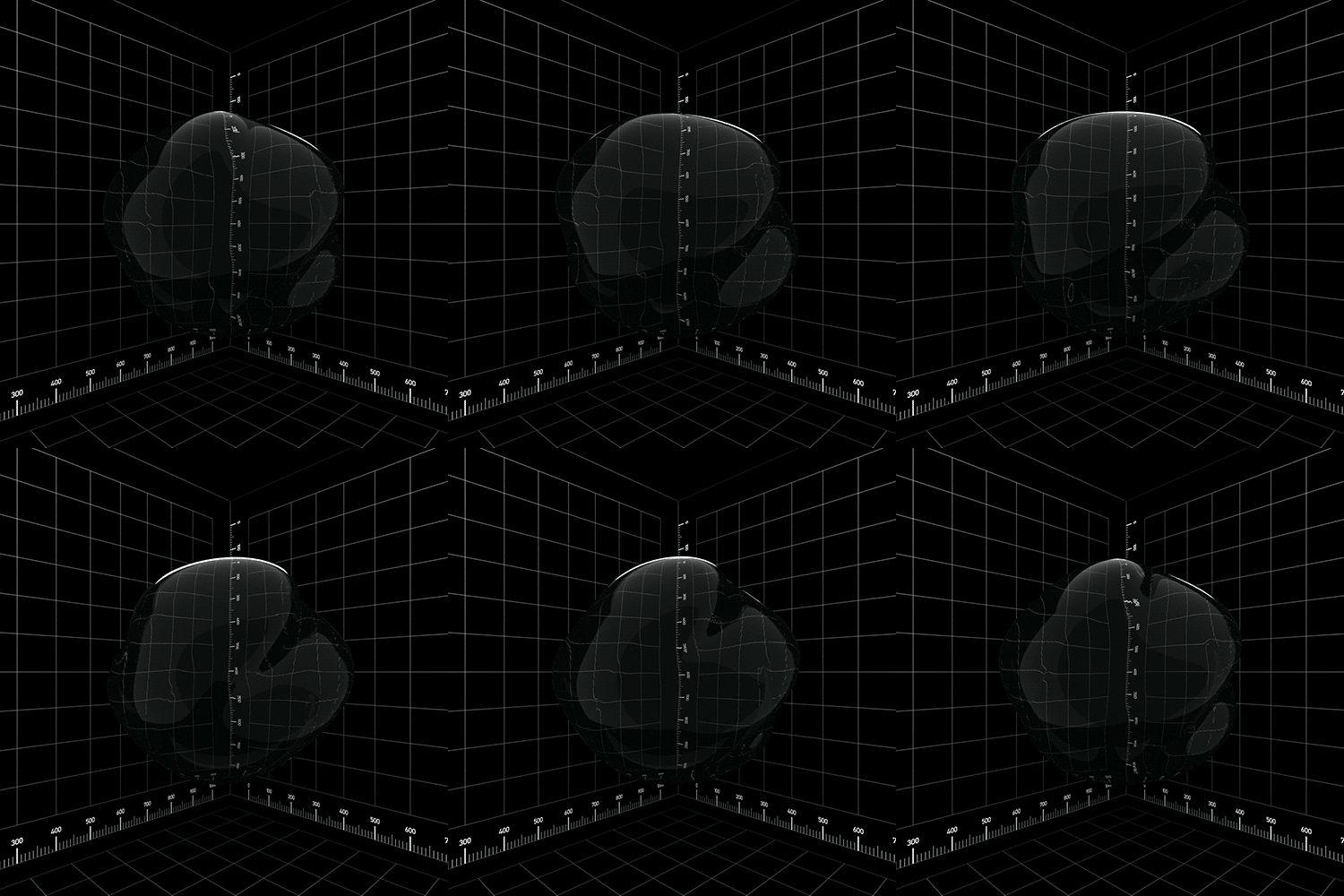
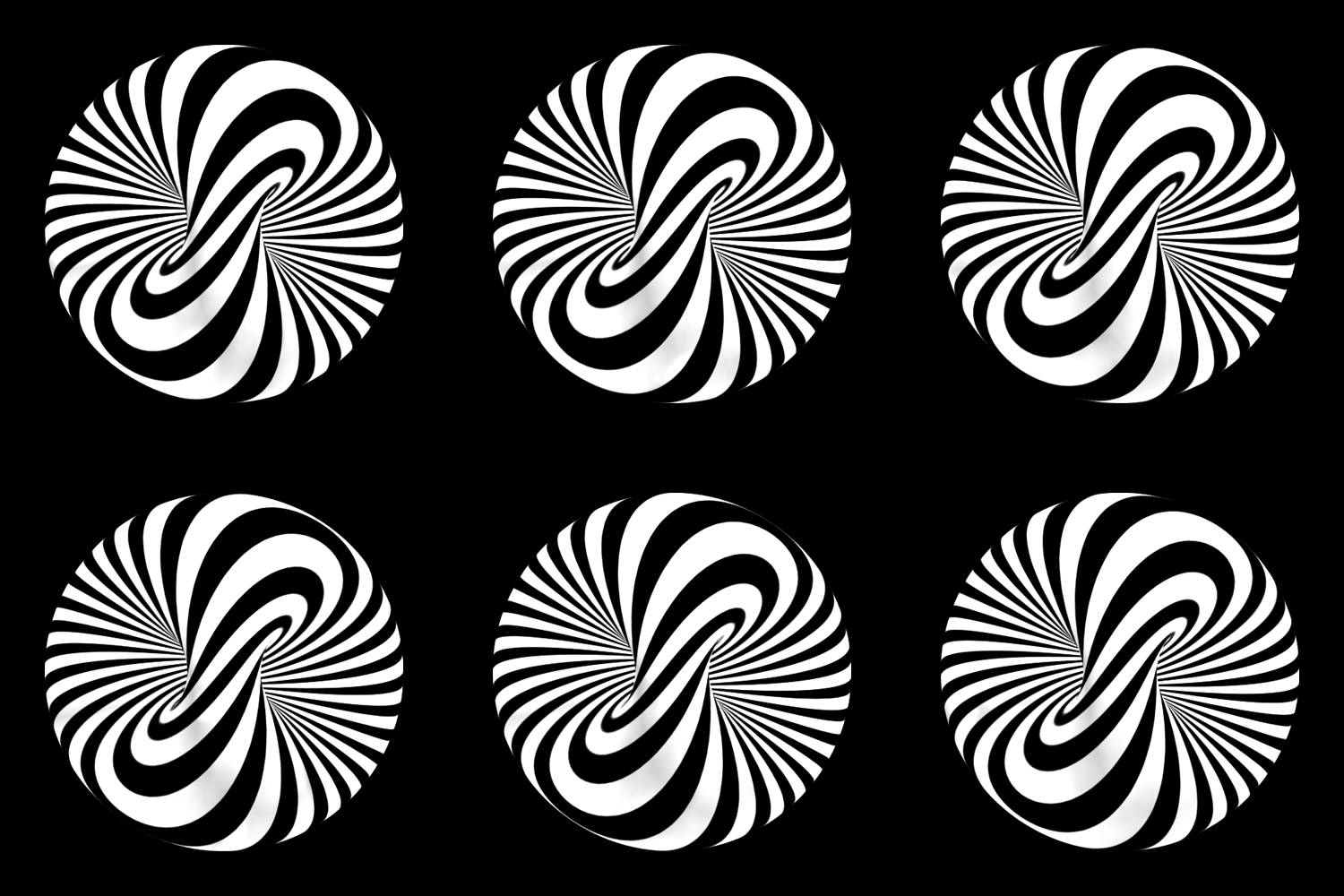
"Stephanie Davidson’s works are, for lack of a better word, super bratty. Like she totally knows it, too. It’s loaded with post-modern irony lost in the throes of youthful know-it-allness. (My Swedish friend calls them: Besser-Vissers. Better knowers? I always liked this invented word.) It’s kinda like wearing a scrunchie and reading the Babysitter’s Club while blasting Boyz II Men just for the kicks of a patronizingly late 90’s obtuse reference, regardless of how little I actually like it. Or, like staring into a gradient-laden orb slowly rotating a white wizzard in the middle of space." - Beautiful/Decay

Wednesday, December 9, 2009

Hans-Christian Schink


Hans-Christian Schink

Work from 1h.

"“1 h” was a long term project which German photographer Hans-Christian Schink undertook in 2003. The result of the project – a photography series – consists of two parts each made up of 12 photographs taken in different places in the northern and southern hemispheres. The images depict the “movement” of the sun in the sky during one hour. The artist’s aim was to create images depicting time as an abstract phenomenon.


The inspiration for the project came from American photographer Minor White’s image “The Black Sun” (1955) in which due to a frozen shutter that caused extreme overexposure White had accidently captured the sun as a black hole in the sky. Schink wondered whether this effect known as “true solarisation” might also work with a much longer exposure, i.e., an exposure of one hour. Another notable fact is that the angle of the line of the sun’s “course” varies depending on the latitude where the photograph is taken – in the far north during the summer months when the midnight sun can be observed the line is horizontal, but on the Tropic of Cancer in the summer solstice it is almost vertical." - RIXC Gallery

Tuesday, December 8, 2009

Wakaba Noda


Wakaba Noda

Work from Blink and Making a Map.

"The above work is taken from Noda’s “Blink”, a series of diptychs. This series was given an honorable mention by famed critic Kotaro Iizawa at the 2006 Canon “New Cosmos of Photography” competition. About this work, Noda says that she “tried to make the physical body reaction (blink) into a photographic image. To blink is something that we can not really control. (Of course we can blink intentionally.) I wondered and visualized what I am missing in the little moment when I blink. So that is why I used two pictures to show a little difference and moment between there.” - Japan Exposures

______________________

"Trying to create a perfect place by assembling photographs of small wonders, Noda makes a map of a world not defined by geography, but by the possibilities that photography offers. Making A Map is Wakaba Noda’s first book." - Farewell Books

Monday, December 7, 2009

Jillian McDonald


Jillian McDonald

Work from Horror Make-Up.

"IT was a sweltering Saturday afternoon on an L train hurtling across Manhattan toward Brooklyn. The last car held the usual assortment of characters: two women shrieking about a recent outing to a hardware store while a man lounged before them, guffawing; a young woman hiding behind sunglasses and iPod earbuds; a scruffy man slumped beside his messenger bag. Nobody paid much attention as a slender, elegant young woman began to enact a ritual familiar to subway riders: peering intently into a tiny mirror, she carefully started to make up her face.

Swiftly, though, it became clear that this was makeup with a difference. She was slathering her face with thick white paste, applying dark circles around her eyes and enhancing her frown lines and nostrils with blackmarks. Although she attracted a few glances, most of the other passengers maintained studiously blank expressions. Only when she slipped in a pair of green teeth and began daubing her face with fake blood did people start to stare, exchange meaningful glances and roll their eyes.

When the train reached Morgan Avenue in Bushwick, the woman stood, grimaced delicately and staggered to the doorway. As the man with the messenger bag hurried out behind her, one of the noisy women hissed, “I think it’s performance art.”

And it was, the latest chapter in the oeuvre of Jillian Mcdonald, a Canadian-born artist who in the last three years has developed something of an underground reputation for work inspired by movie mania. Her climb to cultdom began in 2003 with a series of videos and performances derived from her purported passion for Billy Bob Thornton that have been shown widely at small galleries and nonprofits around the world; her spoof fan site, meandbillybob.com, is linked to by countless blogs.

More recently Ms. Mcdonald has delved into the so-called “zombie renaissance” that some say has been sweeping the nation since around the 2004 remake of George A. Romero’s film “Dawn of the Dead” (1978), the second in his classic zombie series. Her subway performance was filmed with a hidden camera by her boyfriend and sometime collaborator, Beckley Roberts, the scruffy fellow with the messenger bag. Called “Horror Make-Up,” it will make its debut on Sept. 8 at Art Moving Projects, a gallery in Williamsburg, Brooklyn.

Curiously, until four years ago Ms. Mcdonald, now 35, had little interest in either celebrities or zombies. After receiving a master’s of fine arts in nontraditional media in 1999 from Hunter College, she was known mostly for interactive performances that relied on chance encounters with strangers, like placing ads in Canadian newspapers offering her services as a shampoo girl, and then performing in a hair salon or gallery, or passing out chocolate to people in the Union Square subway station in Manhattan.

She found direction when “I was trying to figure out how to make work about celebrity crushes,” she said in an interview. “They fascinate me, and I’d never had one myself.” The answer hit her on the red eye from New York to San Francisco. The film on the flight was “Bandits” (2001), starring Mr. Thornton and Cate Blanchett. Ms. Mcdonald awoke in the dark to see the actors’ lips moving toward each other in slow motion. “I knew immediately and irreversibly that I should be kissing him instead of her,” she wrote later on her Billy Bob Web site. “I was in love.”

The result was “Me and Billy Bob” (2003), a video in which Ms. Mcdonald creates the tale of a doomed love affair by digitally inserting herself into clips from his films. Using scenes from “One False Move,” “The Man Who Wasn’t There,” “Monster’s Ball” and others, she charts the relationship from sappy first encounter to tearful farewell. In the final scene she re-enacts her deus ex machina “Bandits” moment: holding Mr. Thornton’s face in her hands, she slowly moves in for a final, despairing kiss.

In 2004 Ms. Mcdonald videotaped a monthlong performance piece, “Billy Bob Tattoo,” during which she inked her leg each day with his name. Then came “Screen Kiss” (2005), now on view at the Sixtyseven Gallery in Chelsea. In it she splices herself into make-out scenes with other actors, including Ben Stiller, Ewan McGregor, Vincent Gallo and Johnny Depp, culled from movies like “Down With Love,” “Along Came Polly,” and “Before Night Falls.” “Dear Billy Bob,” explains the introduction, “I still love you the best but I can’t wait forever and there are a lot of other fish in the sea.”

After most of the kisses, Ms. Mcdonald turns and stares triumphantly at the camera. But the high point comes in a scene (taken from the campy movie “Original Sin” ) in which she locks lips with Mr. Thornton’s ex, Angelina Jolie. As she nears Ms. Jolie, Ms. Mcdonald’s lips and eyes quavering ridiculously with expectation, it becomes clear that the actress’s features are doing exactly the same thing.

What intrigues viewers of both videos is how Ms. Mcdonald manages to transform herself so completely into a variety of personas, and how cleverly she modulates her expressions and gazes to match — and thereby send up — those of her digital partners. Technologically, the works look surprisingly sophisticated; yet Ms. Mcdonald made them at home on a Macintosh, using editing and special-effects software that she mastered through Internet research.

Before filming her scenes, she spent hours analyzing her chosen excerpts and memorizing the actors’ movements. Then she set up a camcorder on a tripod and, counting beats, performed before it, using green poster board from a craft store instead of the green screen normally used for special-effects sequences.

She intended to introduce “Me and Billy Bob” on the Web from the start; the site went up before its gallery debut. “Conceptually my plan was to get attention from Billy Bob,” she said. She swiftly drew an enthusiastic response from his fans. “A lot of people think it’s real,” she marveled. “They think I’m in touch with him.” Although at first she feared the actor’s lawyers would complain, Mr. Thornton’s official Web site now links to her fan site, but he has never made contact with her himself.

Along the way, Ms. Mcdonald admits, she did become infatuated with Mr. Thornton. “My friends would tease me about it,” she said. Now, she maintains, the one-sided romance is over, although her boyfriend, Mr. Roberts, bears a striking resemblance to her former crush. (“Everybody tells me that, but I don’t share that with him,” she said.)

Her interest in zombies began in a similar fashion: she was driven to analyze an obsession she didn’t understand. “I find it amazing and fascinating that people are so spellbound,” she said. She has always been terrified by horror movies; initially she conducted research by playing DVD’s while she cowered with the lights on at the other end of the room. But now she’s hooked on the genre, just as she became hooked on Mr. Thornton. And, as in the kissing films, “it came out of my interest in exposing the artifice that lends itself to humor,” she said. “If you can get to the point where it seems ridiculous, then it’s not scary anymore.”

“Zombie Loop,” the first piece in her “Horror Cycle,” is a two-video projection installation that Mr. Roberts filmed this summer on a deserted Wisconsin country road. In it Ms. Mcdonald plays two roles: a white-garbed ingĂ©nue who flees, squealing, and the reanimated rotting corpse who staggers forward relentlessly in pursuit. At the end of each loop the figures switch places.

In “Zombie Portraits” she and nine friends morph into zombies in stages, in a lumpish fashion that suggests B-movie stop-motion animation. (Excerpts from the zombie projects can be seen at jillianmcdonald.net.) As with the digital editing, she researched her special-effects makeup techniques on the Internet. “I’m a big fan of learning things on the Web,” she said.

Yet runaway Web popularity does not necessarily translate into art-world success. Although she continues to receive Billy Bob fan mail, she said, no major art dealers have called. Even so, before long she may begin gathering her own share of zombie acolytes. And in the meantime, “this is my excuse to watch a lot of cheesy movies,” she said. “It’s research.” - Carol Kino for the New York Times

Sunday, December 6, 2009

Semiconductor (Ruth Jarman and Joe Gerhardt)


Semiconductor (Ruth Jarman and Joe Gerhardt)

Work from Black Rain.

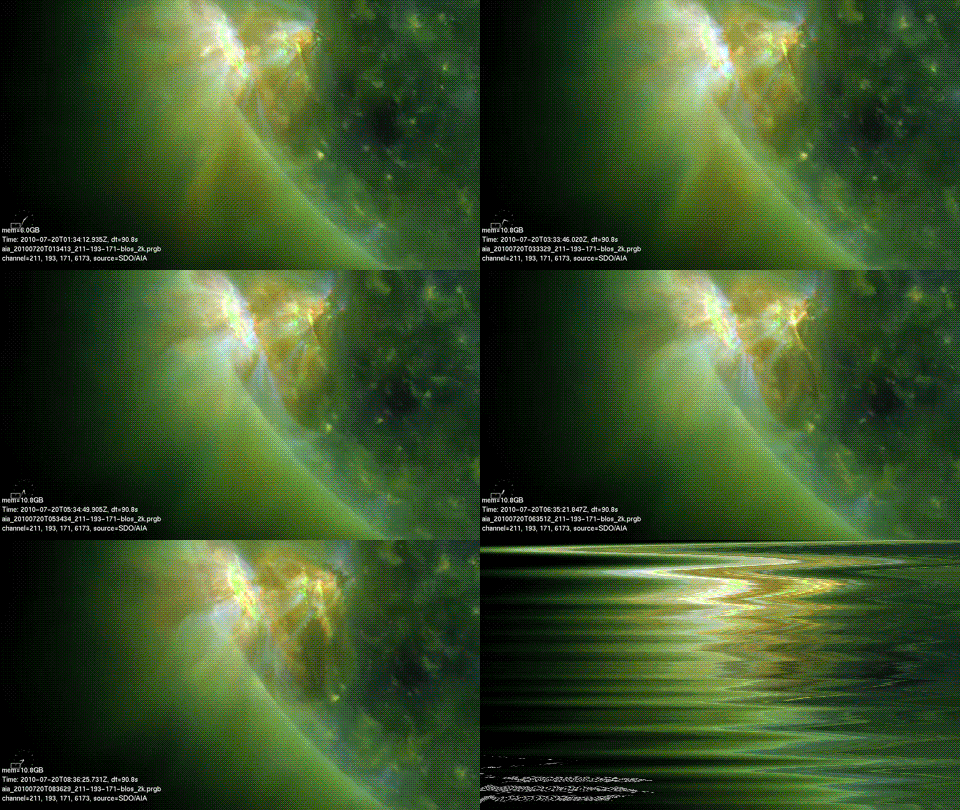
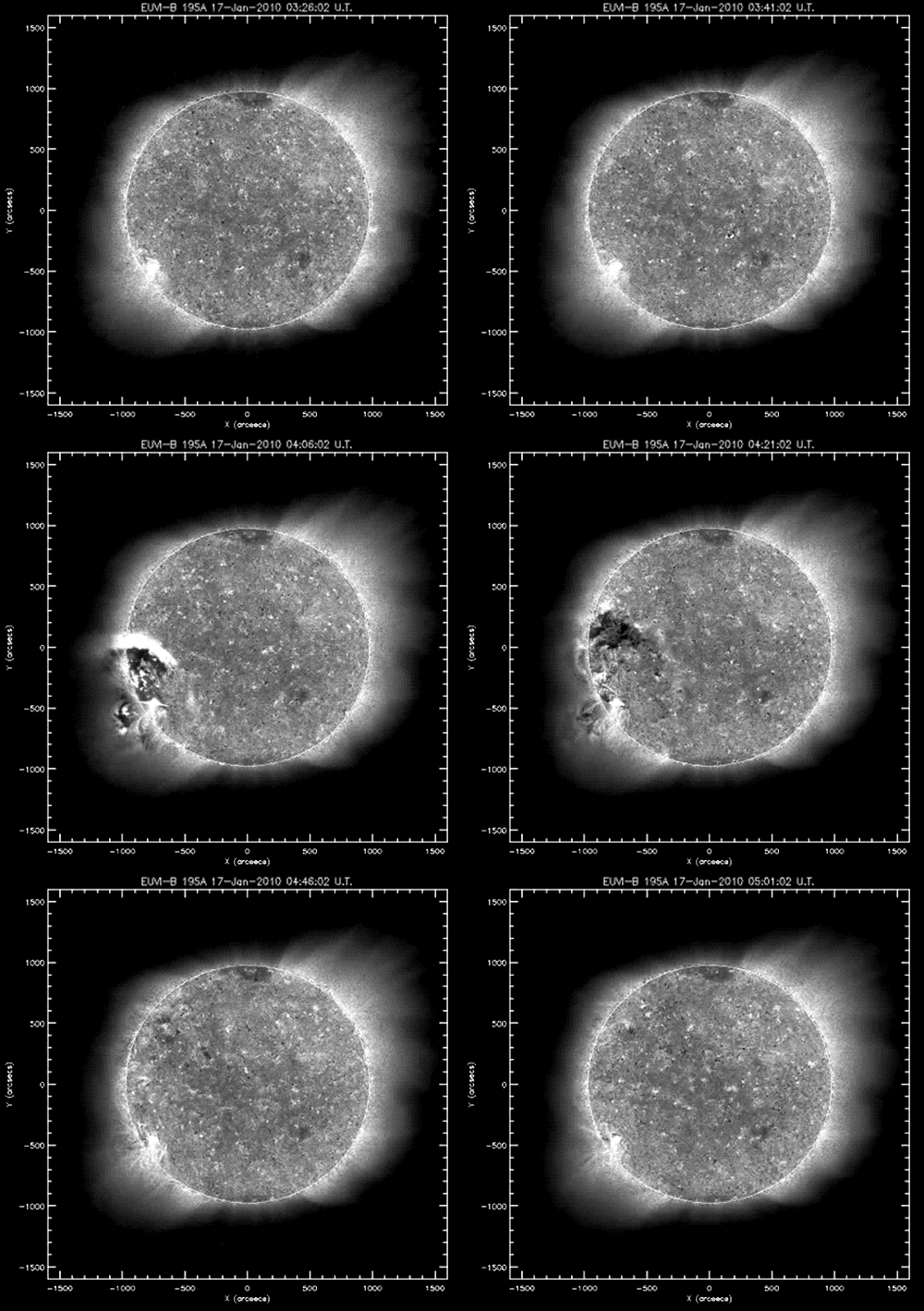
"Black Rain is sourced from images collected by the twin satellite, solar mission, STEREO. Here we see the HI (Heliospheric Imager) visual data as it tracks interplanetary space for solar wind and CME's (coronal mass ejections) heading towards Earth.

Working with STEREO scientists, Semiconductor collected all the HI image data to date, revealing the journey of the satellites from their initial orientation, to their current tracing of the Earth's orbit around the Sun. Solar wind, CME's, passing planets and comets orbiting the sun can be seen as background stars and the milky way pass by.

As in Semiconductors previous work 'Brilliant Noise' which looked into the sun, they work with raw scientific satellite data which has not yet been cleaned and processed for public consumption. By embracing the artifacts, calibration and phenomena of the capturing process we are reminded of the presence of the human observer who endeavors to extend our perceptions and knowledge through technological innovation." - Semiconductor Films